Imparfait vs Passé Composé Explained: Timeline Method
Imparfait vs passé composé trips up every English speaker because English never forces the same choice. You say “I lived there,” and French needs to know if you mean background or event, habit or one-time action, and it will not let you skip the decision.
Why English does not prepare you for this distinction
For English speakers, the biggest problem is not memorizing forms like j’étais or j’ai été. The real problem is that English usually does not force you to choose between background and event in the same precise way. In everyday English, you can often say “I lived there,” “I was living there,” or “I used to live there” with only a small difference in tone. In French, that difference is not optional. You have to decide whether the past action is being presented as an ongoing state, a repeated habit, a description, or a completed event. French grammar forces that decision every time.
That is why so many learners feel fine with present tense and future tense, then suddenly hit a wall with French storytelling. The moment you start talking about childhood, vacations, memories, stories, old jobs, relationships, routines, or interruptions, you need both imparfait and passé composé. If you use only one tense, your French sounds unnatural very quickly.
English uses “read” in both. French does not. The first sentence describes a repeated habit over a period of time, so French uses imparfait. The second describes one finished action with a clear endpoint, so French uses passé composé. Most textbooks explain that mechanically. The actual issue is viewpoint. That is where the timeline method starts to matter.
The easiest mental model: background versus event
The most effective way to understand these two tenses is to stop thinking in terms of “past tense one” and “past tense two.” Instead, think in terms of background and event.
Imparfait gives background. It describes what things were like, what was happening, what people used to do, what the situation looked like, what the mood was, what time it was, what the weather was like, what somebody felt, knew, wanted, or thought.
Passé composé gives events. It tells you what happened, what occurred, what changed the situation, what moved the story forward, what started, what ended, what happened once, or what happened at a specific moment.
Quick rule
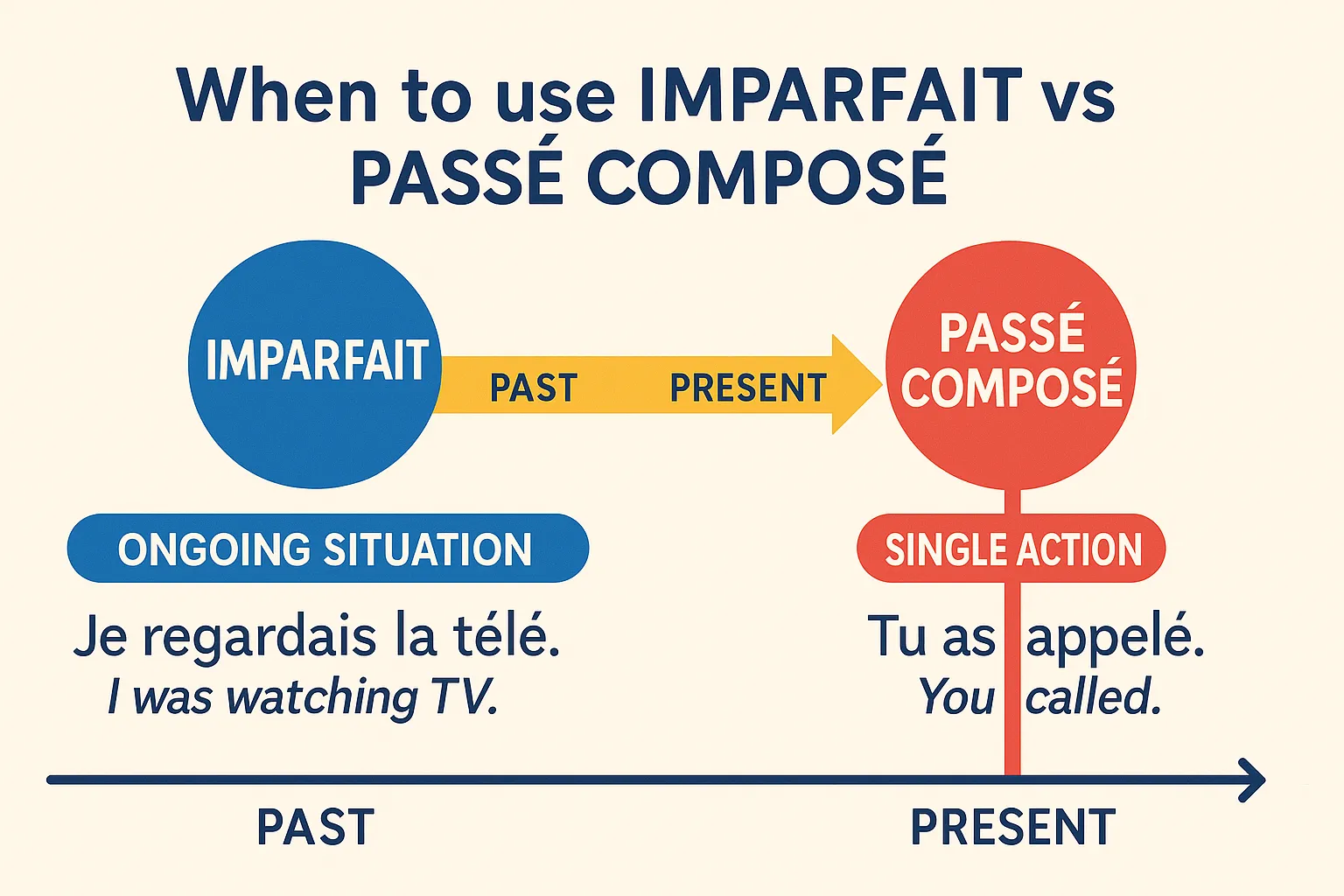
Imparfait = background, description, repeated habit, ongoing action.
Passé composé = completed event, one-time action, narrative step, change.
That sounds almost too simple. Good. It should. Most B1 students do not need a philosophical explanation here. They need a fast decision model they can use under pressure. The nuance comes next.
The timeline method: think like a film director
The timeline method works because it gives you a visual system. Imagine a film scene. Some things form the backdrop: the weather, the setting, the emotional state, the actions already in progress. That is imparfait. Then something happens: the phone rings, someone enters, a glass falls, the train arrives, a decision is made. That is passé composé.
Everything before soudain is background. The cold, the empty street, the walking in progress: all of that is the scene. Then the car braking is the event that interrupts and changes the situation. French marks that change clearly.
If you are not sure which tense to use, ask yourself one question: am I painting the scene, or am I advancing the story?
Use imparfait for description in the past
Descriptions almost always take imparfait. This includes physical descriptions, emotional states, weather, time, age, and general conditions. These things do not usually appear as isolated completed events. They exist as the background frame around other actions.
These are not events on a timeline. They are conditions. That is why imparfait is natural here. Same logic for mental states. If you are describing what somebody felt, knew, wanted, or believed over a stretch of time, imparfait is usually doing the heavy lifting. The same mismatch between what feels logical in English and what French actually demands shows up in words that look English but carry completely different weight in French.
Use imparfait for habits and repeated actions
If something happened regularly in the past, French usually uses imparfait. This is one of the clearest uses. When you say what you used to do, where you used to go, what your family did every summer, how your teacher behaved, what happened every Sunday, you are in habitual past territory.
Markers like toujours, souvent, d’habitude, chaque jour, autrefois, or quand j’étais jeune often push you toward imparfait because they frame the action as repeated or ongoing rather than punctual. Learners who still repeat the same structural errors English speakers default to often confuse these habitual markers with punctual ones.
Use imparfait for ongoing actions in progress
If an action was already in progress in the past, especially when another event happened, French uses imparfait. This is where English often uses “was doing.”
This is one of the most useful patterns in all French grammar. Learn it hard enough and the rest starts to look less random.
Use passé composé for specific completed events
Passé composé is the tense of completed actions. Something happened, finished, and became a clear point in the story. If you can put the action on a timeline as one narrative step, passé composé is often the right choice.
These actions happened as distinct units. They are not just background conditions. They are the plot points. If you tell a sequence of actions in order, you are usually in passé composé territory.
That is pure narrative. One thing happened, then the next, then the next. French wants those steps marked clearly. This same tension between what English flattens and what French insists on distinguishing shows up across the language, including in structural calques like “I am agree” that reveal deeper interference patterns.
When mental state verbs stay in the background
Verbs like être, avoir, savoir, penser, vouloir, aimer, croire, and espérer are very often used in imparfait when they describe an ongoing state of mind or feeling in the past.
This is because these verbs often describe an internal state rather than a single event. They help build the psychological background of the story. But this is exactly where learners overgeneralize, and then French pushes back.
But sometimes those same verbs become events
A verb like savoir or vouloir is often in imparfait, but not always. If the meaning becomes a specific event, a sudden realization, or a completed decision, French can switch to passé composé.
Same verb. Different viewpoint. That is the whole game. If the verb expresses a state, imparfait often works. If it becomes a punctual event, French flips to passé composé. Most learners do not miss this because the rule is hard. They miss it because English does not force them to notice the meaning shift in the first place. The same blind spot shows up with French words that simply have no English equivalent. The problem is not vocabulary, it is that English never carved out that conceptual space. “For sure.”
Time markers that push the choice
Some expressions strongly suggest habitual or ongoing past. Others point to a specific event or one-time occurrence. They do not mechanically decide the tense alone, but they are strong signals.
Markers that often point to imparfait
- tous les jours
- chaque semaine
- souvent
- d’habitude
- en général
- quand j’étais jeune
- à cette époque
- autrefois
- pendant que
Markers that often point to passé composé
- hier
- ce matin
- la semaine dernière
- en 2022
- à huit heures
- soudain
- tout à coup
- une fois
- puis
- ensuite
- finalement
The “pendant” trap
This is one of the most confusing points for English speakers. The word pendant can appear with both tenses depending on the meaning.
With a finished duration, French often uses passé composé. With pendant que introducing simultaneous ongoing actions, imparfait is often the natural choice.
The first is a completed period with a beginning and an end. The second is a simultaneous background action. Same surface word. Different temporal logic. If these viewpoint shifts still feel random, The French Briefing puts them in front of you daily: real French stories where the tense choice is visible and natural, not drilled in isolation.
The two most common mistakes English speakers make
The first mistake is using passé composé for everything. The second is overcorrecting and using imparfait for specific events. Both errors come from the same source: treating French past tenses as form first, meaning second.
The first presents childhood as a period of life. The second presents specific actions as narrative steps. If you swap the tenses, French starts sounding either fragmented or vague.
Ask what the sentence is doing. If it sets the scene, use imparfait. If it tells what happened, use passé composé. Under pressure, that rule beats abstract grammar labels every time.
How to practise this without getting lost
The best method is not to memorize huge tables first. The best method is to train yourself to tell short stories and label each sentence as background or event. Start with very simple narratives: your last vacation, a childhood memory, an embarrassing moment, a school memory, or a rainy day when something happened.
-
1
Set the scene in imparfaitDescribe the weather, time, place, mood, or routine before anything happens.
-
2
Introduce the event in passé composéAdd the action that changes the situation or moves the story forward.
-
3
Return to background if neededFeelings, reactions, and ongoing actions often switch back to imparfait.
-
4
Continue the sequence with passé composéOnce the story is moving, completed actions usually stay in passé composé.
That is natural French narrative rhythm. If you want another grammar point that forces the same kind of viewpoint shift, the subjunctive sits in the same problem zone: English intuition feels logical, French usage says otherwise. And once you start noticing these viewpoint decisions, the reflex of running every sentence through English before speaking starts to break down. Which is the real goal.
Study glossary – French past tense vocabulary
| French Term | English Translation | Usage Example |
|---|---|---|
| L’imparfait | Imperfect tense | On utilise l’imparfait pour les descriptions |
| Le passé composé | Compound past tense | Le passé composé exprime une action terminée |
| Une action terminée | A completed action | J’ai fini mes devoirs |
| Une action habituelle | A habitual action | Quand j’étais petit, je jouais |
| Une description | A description | Il faisait beau |
| Un état | A state | J’étais fatigué |
| Soudain / Tout à coup | Suddenly | Soudain, il est arrivé |
| Tous les jours | Every day | Tous les jours, je me levais tôt |
| Hier | Yesterday | Hier, j’ai vu Marie |
| Autrefois | Formerly / In the past | Autrefois, on écrivait plus de lettres |
| Pendant que | While | Pendant qu’il dormait, je lisais |
| Quand | When | Quand j’étais petit |
From confusion to automatic choice
The imparfait versus passé composé problem feels brutal because it combines form, meaning, and storytelling logic. But once you stop asking which past tense is correct and start asking whether you are describing the background or narrating the event, the system becomes much easier. French is not asking you to guess randomly. It is asking you to choose a viewpoint.
Use imparfait for the scene, the atmosphere, the repeated habits, the ongoing states, and the actions already in progress. Use passé composé for the actions that happen, finish, and move the story forward. That contrast comes back everywhere in real French. And once you see it, you stop translating tense names and start reading the scene itself. “For sure.” 🕶️
Go further

Stop making the same 21 French mistakes. Play them away.
300 pages of games, riddles and quizzes built around the 21 mistakes English speakers actually make in French. You fix them by playing, not by memorising rules. By Camille Aubert.
📚 Keep building in the Learning Center
French Property Taxes for English Speakers: Taxe Foncière Explained
Most anglophone owners discover French property taxes the hard way: a notice arrives in late August, in administrative…
Read →French Subjunctive Made Simple for English Speakers
The French subjunctive has one job: it marks that something is filtered through a mind, not stated as…
Read →French Political Vocabulary – Understanding Elections and Government
France has both a president and a prime minister, and the president is more powerful. "Libéral" means free-market,…
Read →